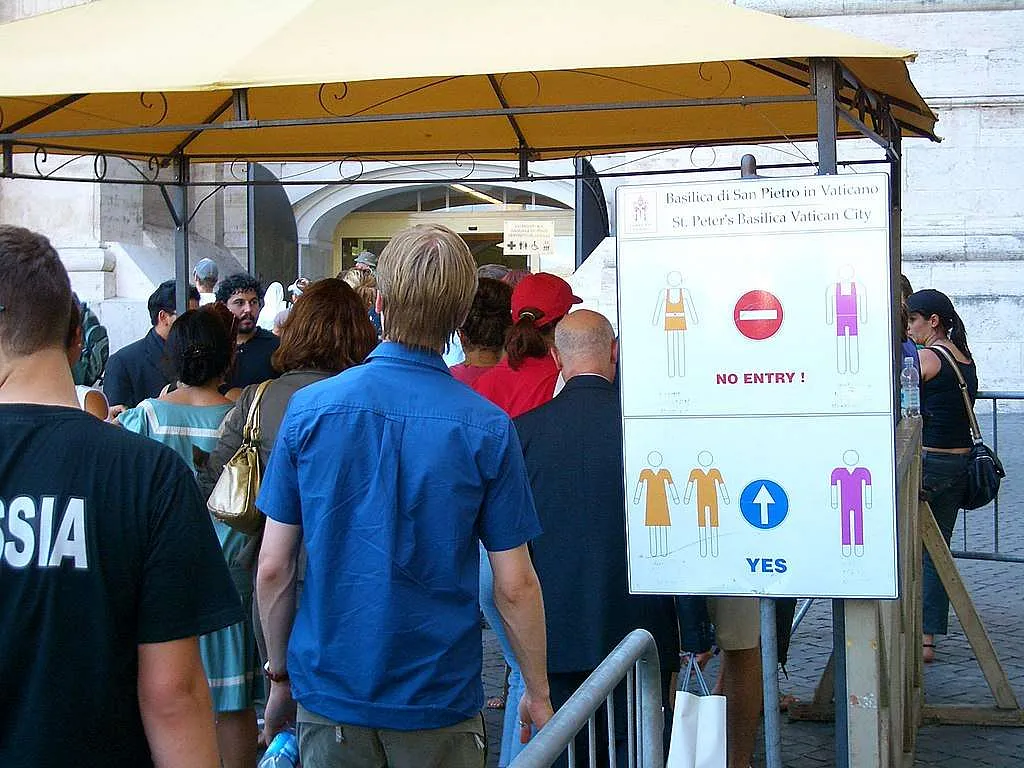
The Vatican dress code is not a suggestion. It is enforced at the entrance to St Peter’s Basilica, and people are turned away every day. I have watched it happen dozens of times - tourists who have queued for an hour discovering at the door that their outfit does not meet the requirements.
The rules are straightforward. The enforcement is inconsistent. Here is what you actually need to know.
The official rules
Both men and women must have shoulders and knees covered. No sleeveless tops, no shorts above the knee, no low-cut necklines, no see-through clothing. Hats must be removed inside the basilica (though they are fine in the square and museums).
These rules apply to St Peter’s Basilica, the Sistine Chapel, and all churches within Vatican City. The Vatican Museums have the same rules but enforce them less strictly - I have seen people in the gallery corridors wearing clothes that would get them stopped at the basilica door.
Carry a light scarf or pashmina in your bag. It solves every dress code issue. Wrap it around bare shoulders, drape it over shorts as a makeshift skirt. I have seen this save dozens of visits.
The dress code is enforced most strictly at St Peter's Basilica main entrance and least strictly at the museum entrance. Plan your visit accordingly if you are wearing borderline clothing.
Dark colours and modest cuts will never cause a problem. When in doubt, think 'visiting a church' rather than 'tourist sightseeing'.
What actually gets enforced
The strict enforcement happens at the basilica. Security guards stand at the entrance and visually check every visitor. Bare shoulders are the most common reason for being turned away. Shorts above the knee are the second.
At the museums, the check happens at the initial security screening. It is less thorough. I have seen people in shorter shorts make it through the museum queue when they would have been stopped at the basilica. However, the Sistine Chapel is at the end of the museum route, and the guards there can be stricter.
The seasons matter
In summer - June through September - the enforcement is at its most visible because the clothing violations are at their most frequent. Rome is hot. People dress for the weather. The Vatican expects you to dress for the church.
In winter, the dress code is rarely an issue because everyone is already covered up. If you are visiting between November and March, you almost certainly do not need to think about it.
The practical workaround
Every experienced Rome visitor knows this trick: carry a scarf. A lightweight pashmina or large scarf solves every dress code problem. Wrap it around bare shoulders. Tie it as a sarong over shorts. It takes up almost no space in a bag and saves you from being turned away after an hour in the queue.
You can also buy cheap scarves from the street vendors near the Vatican. They know exactly why you need one and they will charge you accordingly - expect to pay between five and ten euros for a basic shawl that does the job.
What about the Pope
If you are attending a papal audience, the dress code is similar but slightly more relaxed. You are in the open square rather than inside a church. Shoulders covered, knees covered, but the enforcement is softer because the logistics of checking 30,000 people are different from checking people entering a door one by one.
For a private audience or small group meeting with the Pope, the dress code is formal. Women traditionally wear black with a veil. Men wear dark suits. This is protocol, not just preference.