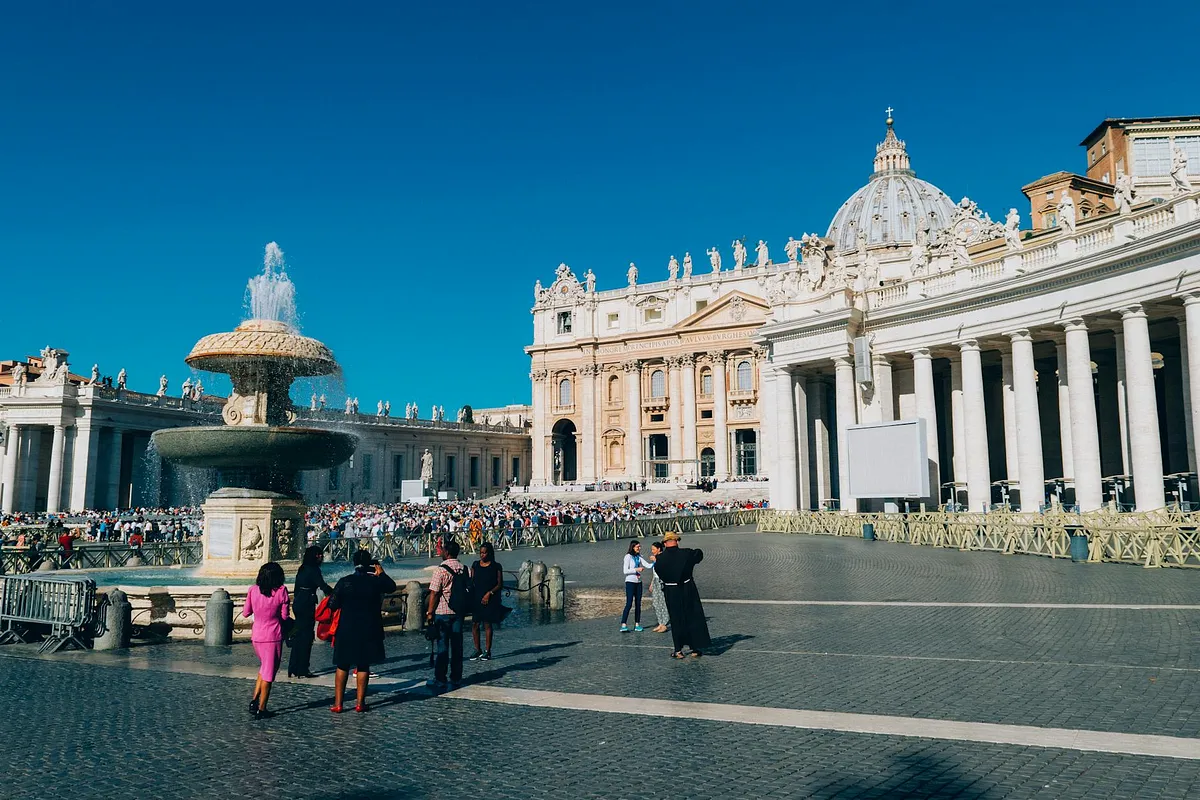
PATRICK ANSWERS: Yes, you can do the Vatican in one day - but only with a plan. Start at the museums at 8:00 AM, follow the standard route to the Sistine Chapel, use the internal passage to St. Peter’s Basilica, climb the dome if you have the energy, and finish in St. Peter’s Square by mid-afternoon. Walk into Prati for lunch. Don’t wing it.
The Vatican can feel like two places at once: a living heart of Catholic worship, and the world’s most compressed museum complex. Pilgrims arrive carrying intentions; cultural visitors arrive carrying lists; both quickly discover the same obstacle: crowds, security lines, and the quiet pressure of “seeing it all” in a single day. The antidote is not speed, but sequence. When you enter the Vatican Museums at opening, you walk the long corridors before they become a human tide; you reach Michelangelo’s ceiling whilst there is still space to lift your eyes; you step into St. Peter’s Basilica not as a survivor of queues, but as a visitor with attention left to give. This itinerary is designed for one complete day: precise timing, realistic pacing, and small moments of reverence, ending, as it should, in the open geometry of St. Peter’s Square.
Before you arrive: tickets, dress code, and the closure calendar
The Vatican Museums operate under a non-refundable ticketing system that rewards early planning. Book directly through tickets.museivaticani.va sixty to ninety days before your visit. A standard ticket costs EUR20, with an additional EUR5 for skip-the-line access; reduced tickets for students under twenty-five or children aged seven to eighteen are EUR10 plus EUR5. Children under six enter free, but you must still reserve their slot. The booking fee adds roughly EUR6.50, bringing your total to approximately EUR31.50 per adult. Third-party platforms such as Viator offer guided skip-the-line tours from EUR50 to EUR100, which include an escort through security and timed commentary. These prove useful if you are anxious about navigating alone, though they are not strictly necessary if you follow this schedule.
The dress code is enforced at every checkpoint: knees and shoulders must be covered, and flip-flops are forbidden. Men in shorts or women in sleeveless tops will be turned away at the Museums entrance and again at St. Peter’s Basilica. Carry a lightweight shawl or cardigan even in summer; security staff do not negotiate. The Vatican observes a dense closure calendar: 1 January, 6 January, 11 February, 19 March, Easter Monday, 1 May, 29 June, 14-15 August, 1 November, 8 December, and 25-26 December. Temporary Sistine Chapel closures for papal ceremonies also occur at short notice, so check museivaticani.va the week before your visit. Wednesday papal audiences at 10:30 AM disrupt the usual flow; avoid Wednesdays unless you intend to attend the audience itself, which requires a separate free ticket requested weeks in advance.
The one-day Vatican itinerary (timed plan from 6:30 AM to 5:00 PM)
6:30-7:30 AM: Wake early. Check your outfit against the dress code. Eat a light breakfast at your hotel. Roman bars near Prati serve espresso and cornetti, but queues form after 7:30 AM. Print or download your ticket confirmation; mobile tickets are accepted, but battery anxiety is real.
7:30-8:00 AM: Take Metro Line A to Cipro-Musei Vaticani (one stop before Ottaviano). Exit and follow signs for Viale Vaticano; the Museums entrance is a five-minute walk. Alternatively, buses 23, 49, 81, or 492 stop along Viale Vaticano, though the Metro is faster. Arrive at the entrance by 7:45 AM. Security screening begins at 7:50 AM for 8:00 AM ticket holders. Queues are short at this hour; by 9:00 AM, they stretch fifty metres.
8:00-11:30 AM: Enter the Museums. The standard route funnels you through the Pinacoteca (often skipped, but it holds Caravaggio’s Deposition and Raphael’s Transfiguration), then the Gallery of Maps, a 120-metre corridor of sixteenth-century topographical frescoes that pilgrims used to study the geography of Christendom. The Raphael Rooms follow: four chambers where Raphael’s School of Athens compresses philosophy and theology into a single fresco. Finally, the Sistine Chapel. You will have roughly thirty minutes here before the crowds thicken. Focus on Michelangelo’s Creation of Adam (the central ceiling panel) and the Last Judgment on the altar wall, a work that took eight years and remains the Church’s most confronting meditation on salvation and damnation. Guards enforce silence; no photographs, no pointing, no sitting on the floor. If you arrive at 1:00 PM instead, the chapel is quieter, as most tour groups depart for lunch, but you sacrifice the calm of the earlier galleries.
For a deeper gallery-by-gallery breakdown, see our Vatican Museums honest guide.
11:30 AM-12:30 PM: Exit the Museums and walk directly to St. Peter’s Basilica. The internal passage from the Sistine Chapel deposits you near the Basilica entrance, bypassing the external queue. Entry is free. Immediately to your right as you enter is Michelangelo’s Pieta, carved when he was twenty-four and still the most technically perfect sculpture in Rome. The main altar sits beneath Bernini’s bronze baldachin, a Baroque canopy that rises twenty-nine metres and marks the tomb of St. Peter. The scale of the Basilica, at 211 metres long and 136 metres at the dome’s apex, makes it difficult to absorb in one visit. Walk slowly.
To understand the popes who built all of this, our guide to which pope built St. Peter’s Basilica covers the full story.
Patrick’s Tips:
- Arrive at the museum entrance by 7:45 AM - by 9:00 AM, queues are fifty metres long
- Use the internal Sistine Chapel passage to reach St. Peter’s Basilica without re-queuing
- Do the museums first while you’re fresh, the basilica second when you’re tired
- If you only have time for one add-on, choose the dome climb over the papal tombs
- Avoid Wednesdays unless you want to attend the papal audience
Vatican Museums to Sistine Chapel: the crowd-avoiding route that still honours the masterpieces
The Museums contain eleven kilometres of corridors. You cannot see everything, nor should you try. The route I recommend - Pinacoteca, Gallery of Maps, Raphael Rooms, and Sistine Chapel - takes three and a half hours at a deliberate pace and prioritises works that shaped Catholic visual theology. The Gallery of Maps, for instance, is not merely decorative; it was commissioned by Pope Gregory XIII to assert the Church’s intellectual authority over geography during the Counter-Reformation. The Raphael Rooms, particularly the Disputation of the Holy Sacrament, present the Eucharist as the centre of Christian doctrine, a direct response to Protestant challenges. The Sistine Chapel ceiling, completed in 1512, reframes Genesis as a narrative of human potential and divine grace, whilst the Last Judgment (1541) reflects the darker mood of the Reformation’s aftermath. These are not tourist attractions; they are arguments in paint and plaster, and they require context to resonate.
Bottlenecks form at the Sistine Chapel entrance and the Gallery of Tapestries. If you are running late, skip the Pinacoteca and enter directly via the courtyard staircase to the Gallery of Maps. Do not attempt the Vatican Gardens without a pre-booked guided tour (available Tuesdays, Thursdays, and Saturdays only; EUR46 including Museums entry). The gardens are a Renaissance retreat designed for papal contemplation, but they add two hours to your schedule.
”Skip-the-line” vs. “early entry”: what actually saves time (and what is a tourist trap)
The term “skip-the-line” is misleading. Every ticket, whether purchased at EUR20 or EUR100, requires you to pass through security screening. What you are paying for is a reserved time slot and, in the case of guided tours, an escort who can answer questions and navigate the one-way system. The official EUR5 skip-the-line fee is worth it; third-party tours are worth it only if you value live commentary over independent exploration.
The genuine tourist trap is the last Sunday of each month, when entry is free. Queues begin at 6:00 AM and stretch around the Vatican walls; the Sistine Chapel becomes standing-room-only. Avoid this unless you are on a strict budget and have no alternative. Similarly, avoid arriving without a pre-booked ticket. Ticket offices at the entrance sell same-day access, but queues can exceed two hours during high season. Nearby cafes along Viale Vaticano charge EUR8 for a panino and EUR5 for bottled water; walk ten minutes into Prati for authentic Roman pricing.
Patrick’s Tip: The free last Sunday sounds great but it’s a trap. I’ve seen people queue for three hours and then spend an hour shoulder-to-shoulder in the Sistine Chapel. Pay the EUR31.50 and go on a weekday morning.
St. Peter’s Basilica and the dome: when to climb, when to go underground, and how to keep your energy
The dome costs EUR10 (EUR8 if you take the lift to the first terrace, then climb 320 steps; EUR10 for all 551 steps). The climb is narrow, steep, and claustrophobic in sections. The final spiral staircase tilts inward as it follows the dome’s curve. The reward is a 360-degree view of Rome and the Vatican Gardens, and the chance to stand at the base of the lantern, where Michelangelo’s architectural vision culminates. If you have limited energy, choose the dome over the papal tombs; the tombs are moving, with John Paul II’s simple sarcophagus drawing pilgrims daily, but they are underground, poorly lit, and require queuing again.
The Basilica’s treasury, located near the sacristy, holds Bernini’s ciborium and medieval papal vestments. It is underrated and rarely crowded. If you are a pilgrim, this is where you will feel the weight of continuity: objects used in Mass for centuries, still venerated, still functional.
Finish in St. Peter’s Square: reflection, photos, and the practical exit into Prati
St. Peter’s Square, designed by Bernini in 1656, is an ellipse embraced by 284 columns, an architectural metaphor for the Church gathering the faithful. The Egyptian obelisk at its centre, brought to Rome by Caligula, predates Christianity by fifteen centuries. Stand at one of the two circular stones set into the pavement; from these points, Bernini’s four-deep colonnade aligns into a single row, a Baroque trick of perspective that still astonishes.
Exit via Via della Conciliazione towards Prati. For lunch, Hostaria dei Bastioni (Via Leone IV) serves carbonara for EUR12 and suppli for EUR3, authentic Roman trattoria pricing. Porto Fish & Chips (Via Vespasiano) offers fresh seafood from EUR30 per person. Stay in Prati if you want calm - it’s where Romans actually eat, away from the tourist-trap restaurants around the square. Metro Line A at Ottaviano returns you to Termini in fifteen minutes.
The Vatican is exhausting, but it is also structurally logical. Follow the sequence, respect the silences, and you will leave not overwhelmed, but quietly changed.
Patrick’s Pick: If you want a guided tour that covers this exact itinerary - museums, Sistine Chapel, and basilica in one morning - Viator’s Vatican Museums, Sistine Chapel and St. Peter’s Basilica Tour is the one I’d book. Skip-the-line, good pacing, and they know the internal passage shortcut.
Frequently Asked Questions
- Can you see the Vatican in one day?
- Yes, but only with a plan. This itinerary covers the Vatican Museums, Sistine Chapel, St. Peter's Basilica, and the dome climb in a single day with realistic pacing.
- What time should I arrive at the Vatican?
- Aim to be at the Viale Vaticano entrance by 7:45 AM for an 8:00 AM entry slot. Security screening starts at 7:50 AM. By 9:00 AM, queues stretch fifty metres.
- Should I do the Vatican Museums or St. Peter's Basilica first?
- Museums first. They're more exhausting and you want to hit them when you're fresh. The basilica is calmer and easier to navigate when you're already tired.
- Is the dome climb worth it?
- Yes, if you have the energy. The 360-degree view of Rome is one of the best in the city. Take the lift option if your legs are tired from the museums.
- Where should I eat near the Vatican?
- Walk into the Prati neighbourhood. Hostaria dei Bastioni on Via Leone IV serves carbonara for around EUR12. Avoid the tourist-trap restaurants immediately surrounding St. Peter's Square.