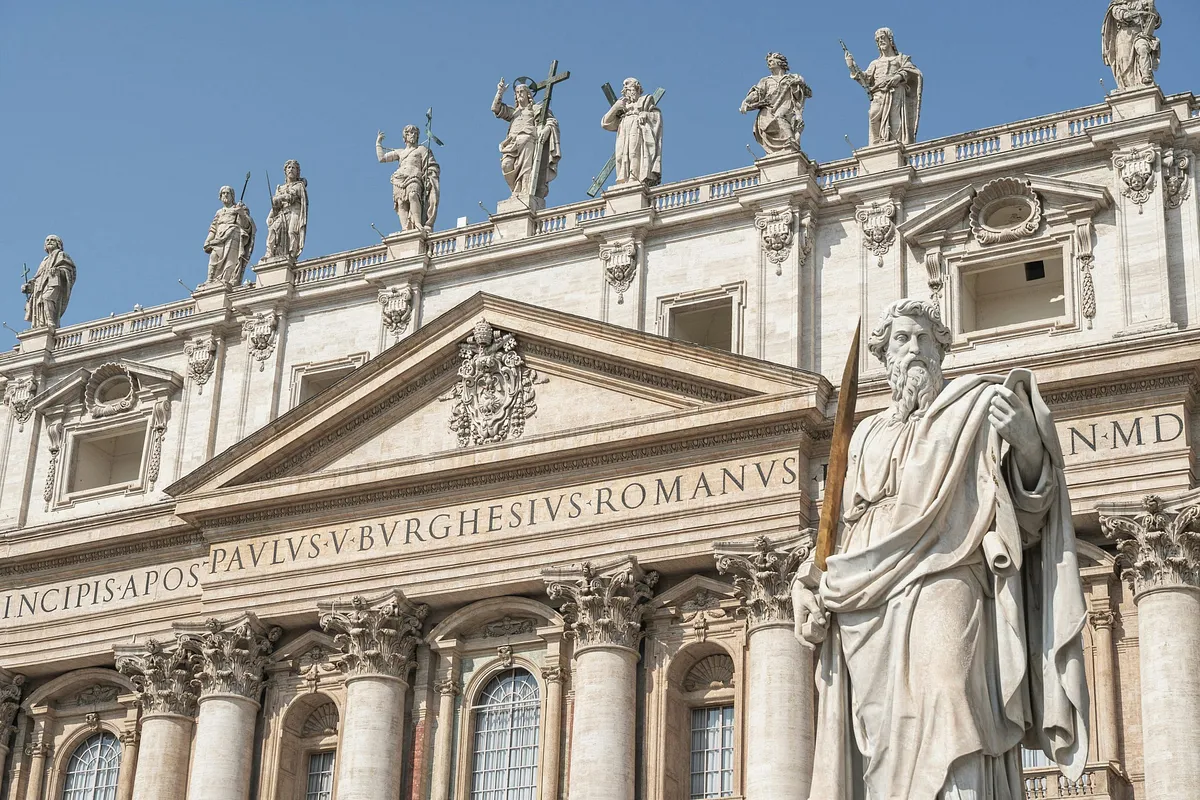
No single pope built St Peter’s Basilica. The construction spanned 120 years, from 1506 to 1626, under the direction of roughly twenty different popes. The project survived theological revolutions, financial crises, architectural feuds, and at least one complete redesign.
The short answer to the question is Pope Julius II started it and Pope Urban VIII finished it. But that leaves out the fascinating middle, which is where the real story lives.
The old basilica
Before the current St Peter’s Basilica, there was another one. The original basilica was built by Emperor Constantine around 326 AD over the site traditionally believed to be the burial place of the Apostle Peter. It stood for over a thousand years.
By the 1400s, the old basilica was in serious trouble. The walls were leaning. The foundations were shifting. Several popes considered renovation, but the scale of the problem kept growing. Pope Nicholas V began strengthening the walls in 1452, but he died before making real progress.
When you visit St Peter's Basilica today, look for the bronze markers on the floor of the nave. They show the comparative lengths of other major churches worldwide. St Peter's is the largest church ever built - 218 metres long inside.
The best time to appreciate the scale of the building is early morning, before the tour groups arrive. The basilica opens at 7:00am and is nearly empty until about 9:00.
Julius II tears it down
In 1506, Pope Julius II made a decision that horrified much of the Christian world. He ordered the demolition of Constantine’s 1,200-year-old basilica and commissioned an entirely new church. This was not renovation. This was replacement.
Julius chose Donato Bramante as his architect. Bramante’s design was radical - a Greek cross plan with a massive central dome, inspired by the Pantheon. The foundation stone was laid on April 18, 1506.
Bramante demolished so much of the old basilica that he earned the nickname “Bramante Ruinante” - Bramante the Destroyer. Precious mosaics, ancient tombs, and irreplaceable artworks were lost in the demolition. It remains one of the most controversial architectural decisions in history.
The funding crisis and the Reformation
Building the largest church in Christendom was staggeringly expensive. To fund the project, Pope Leo X authorised the sale of indulgences - certificates that promised reduced time in purgatory in exchange for financial contributions to the building fund.
This practice was one of the direct triggers for Martin Luther’s Ninety-Five Theses in 1517, which launched the Protestant Reformation. The building of St Peter’s Basilica literally changed the course of Western Christianity.
Michelangelo takes over
By the 1540s, the project had stalled. Multiple architects had come and gone. The design had been changed several times. Pope Paul III turned to Michelangelo, who was 71 years old and deeply reluctant.
Michelangelo simplified Bramante’s original design, returned to the Greek cross plan, and designed the dome that defines the Roman skyline today. He worked on the basilica for the last 18 years of his life, refusing any payment, saying he did it for the glory of God.
Michelangelo died in 1564 with the dome unfinished. The drum - the cylindrical base of the dome - was complete, but the dome itself was not. It was finished by Giacomo della Porta and Domenico Fontana under Pope Sixtus V between 1588 and 1590, working from Michelangelo’s designs but making the dome slightly more pointed than he had intended.
The final stretch
In 1607, Pope Paul V made the controversial decision to extend the basilica into a Latin cross plan, abandoning the Greek cross that Bramante and Michelangelo had both favoured. Carlo Maderno added the long nave and the current facade.
This decision remains debated by architects and historians. The extended nave means you cannot see Michelangelo’s dome properly from the square - Maderno’s facade blocks the view. Stand in Via della Conciliazione approaching the Vatican and you will see the facade dominating where the dome should be the focal point.
Gian Lorenzo Bernini then spent decades on the interior decoration and the spectacular colonnade of St Peter’s Square. The baldachin - the massive bronze canopy over the papal altar - was completed in 1634. The colonnade was finished in 1667.
The consecration
Pope Urban VIII consecrated the completed basilica on November 18, 1626. The date was chosen deliberately - it was exactly 1,300 years after the consecration of Constantine’s original basilica.
The building had taken 120 years, cost the equivalent of billions in modern currency, indirectly triggered the Protestant Reformation, employed the greatest architects and artists of the Renaissance and Baroque periods, and produced the largest and most architecturally significant church in the world.
No single pope built it. But Julius II had the audacity to start it, Michelangelo had the genius to define it, and Urban VIII had the satisfaction of finishing it.